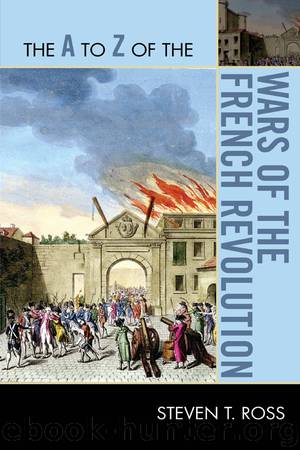
The A to Z of the Wars of the French Revolution by Steven T. Ross
Author:Steven T. Ross
Language: eng
Format: epub
Publisher: Scarecrow Press
Published: 1998-03-14T16:00:00+00:00
NERESHEIM, BATTLE OF (11 AUGUST 1796). The Rhine and Moselle Army with Moreau (q.v.) in command advanced into southern Germany and marched for the Danube. On 11 August, 65,000 French troops faced 56,000 Austrians at Neresheim. Both the Archduke Charles (q.v.) and Moreau ordered attacks. After hard fighting, in which each side lost about 3,000 men, the Austrians retreated. Moreau’s advance in turn enabled Jourdan’s Sambre-Meuse Army to cross the Rhine a second time.
NEUMARCK, BATTLE OF (21 AUGUST 1796). Archduke Charles (q.v.) concentrated his army against Jourdan’s (q.v.) Army of the Sambre-Meuse. He encountered a French advance guard at Neumarck and threatened to turn their right flank. Fighting was minimal, but the French retreated.
NEUWIED, BATTLE OF (18 APRIL 1797). Hoche’s Sambre-Meuse Army crossed the Rhine and occupied Neuwied. The Austrians intended to attack before the entire army had crossed the river, but Hoche (q.v.) attacked first. A frontal attack sustained by a turning movement led by Lefebvre and Richepanse was successful, and the Austrians had to retreat, leaving their supply wagons behind. The Austrians lost some 5,000 men. Hoche then launched a vigorous pursuit. The French occupied Frankfurt, but the Leoben Armistice (q.v.) ended further operations.
NEW ROSS, BATTLE OF (5 JUNE 1798). Irish rebels, about 30,000 strong, attacked the British garrison of New Ross. The rebels were marching on Dublin in hopes of seizing the arsenal and encouraging the French to send aid. The rebels, lacking muskets, were defeated and lost over 2,500 killed. After the battle, the Irish had to retreat back into Wexford. (See also Ireland)
NEY, MICHAEL, GENERAL (1769–1815). Ney was the son of a cooper. He joined the army in 1787 and became a sergeant major. The Revolution offered expanded opportunities, and after the overthrow of the monarchy, Ney became an officer. He fought effectively in numerous campaigns and by 1799 was a general of division. He played a significant role in the battle of Hohenlinden (q.v.). He continued to serve Napoleon, who made him a marshal, a prince and a duke. He accepted the Restoration in 1814, but joined Napoleon during the Hundred Days. After Waterloo, the Bourbons had him arrested, tried, and—stories of his escape to the United States notwithstanding—shot. Ney had a volatile temper and was incredibly brave. He, like many generals of the Republic and Empire, had no real grasp of strategy but was a fine operational and tactical commander.
NILE, BATTLE OF THE (1 AUGUST 1798). In the early spring of 1798 the French government decided to invade Egypt as part of a strategic plan to weaken the British economy and force London to sue for peace. Bonaparte (q.v.) was to conquer Egypt and use the country as a stepping stone for a thrust at India where, in cooperation with the Sultan of Mysore, the French would attack British holdings in the subcontinent, thereby dealing a severe blow to British trade. The French presumed that they could safely traverse the Mediterranean because no major British fleet units had been stationed in the area since Spain had declared war on Britain in 1796.
Download
This site does not store any files on its server. We only index and link to content provided by other sites. Please contact the content providers to delete copyright contents if any and email us, we'll remove relevant links or contents immediately.
| Africa | Americas |
| Arctic & Antarctica | Asia |
| Australia & Oceania | Europe |
| Middle East | Russia |
| United States | World |
| Ancient Civilizations | Military |
| Historical Study & Educational Resources |
Room 212 by Kate Stewart(5119)
The Crown by Robert Lacey(4814)
Endurance: Shackleton's Incredible Voyage by Alfred Lansing(4780)
The Iron Duke by The Iron Duke(4354)
The Rape of Nanking by Iris Chang(4211)
Joan of Arc by Mary Gordon(4109)
Killing England by Bill O'Reilly(4001)
Say Nothing by Patrick Radden Keefe(3983)
I'll Give You the Sun by Jandy Nelson(3445)
Shadow of Night by Deborah Harkness(3367)
Hitler's Monsters by Eric Kurlander(3341)
Mary, Queen of Scots, and the Murder of Lord Darnley by Alison Weir(3210)
Blood and Sand by Alex Von Tunzelmann(3203)
Eleanor & Park by Rainbow Rowell(3169)
Darkest Hour by Anthony McCarten(3129)
Margaret Thatcher: The Autobiography by Thatcher Margaret(3081)
Book of Life by Deborah Harkness(2937)
Red Famine: Stalin's War on Ukraine by Anne Applebaum(2932)
The One Memory of Flora Banks by Emily Barr(2863)
